What More Can We Do? Rethinking Stewardship Through Impact Investing
Nov. 5, 2026
By Scott Renschler, Psy.D., Chair of the Board
At the Bainum Family Foundation, we often talk about responsible stewardship. For my family and the Board, stewardship means more than responsible preservation of our endowment and diligent disbursement of grant funds. It means honoring a legacy of giving, responding to the needs of community, and ensuring that every asset entrusted to us helps advance our vision of a society where all children thrive.
Recently, our Chief Financial Officer, Mike Brannan, shared the story of the Foundation’s impact investing journey and how we have increasingly aligned our endowment with our vision. He outlined how our approach has evolved from traditional investment practices toward a more intentional strategy that pushes to ensure our assets contribute to positive outcomes for children.
As Board Chair, I see impact investing through an expanded lens. For me, impact investing is not primarily an investment strategy. It is a stewardship responsibility.
A Family Tradition of Stewardship
My perspective is deeply influenced by my family’s history.
Long before impact investing terms such as “catalytic capital” and “total portfolio activation” entered the philanthropic mainstream, our founder (and my grandfather), Stewart Bainum Sr., approached philanthropy with determination, creativity, and a deep commitment to broadening access to opportunity.
Grounded in his personal experience navigating economic hardship and barriers to education, he recognized that both pathways to opportunity and impediments to success are too often shaped by factors beyond an individual’s control. Deeply influenced by these experiences, he returned throughout his life to a question that continues to guide our work today as we seek to create a fairer playing field for all:
What more can we do?
That question remains core to the Foundation across generations.
More recently, my predecessor as Board Chair, Barbara Bainum, expanded our understanding of what meaningful support looks like. She challenged the Foundation to think beyond the support of individual children and focus on the other resources, structures, and conditions that enable children to thrive.
Under her guidance, the Foundation increasingly embraced an approach that recognized families often need more than financial assistance. They need access to services, trusted relationships, and practical supports. Her leadership reinforced an important lesson: While financial resources are essential, lasting impact is often built through an ecosystem of supports that help children and families navigate challenges and create stability.
In many ways, our approach to impact investing is an intentional extension of that philosophy. If previous generations of Bainum leadership asked how we could provide more than funding to our partners, today’s Board is asking:
How can all the Foundation’s assets contribute to the change we seek?
Putting Our Philosophy Into Practice
A board’s role is often defined by governance, oversight, and fiduciary duty. Those responsibilities are essential. But effective stewardship requires us to look beyond grant dollars and financial returns alone.
As Board Chair, I view stewardship as broader than overseeing an endowment. To me, it means ensuring that the Foundation’s capital, relationships, reputation, governance, and experience work together in service of our mission of creating a society where all children thrive. The strategic and simultaneous leverage of these resources is a critical component of the systems-level change and sustainable social progress we are working to create alongside our partners.
We’ve already begun putting this philosophy into practice by reexamining how we deploy our financial resources to advance our mission. This includes the family’s decision, supported by the Board, to increase the Foundation’s annual spending commitment to up to 10% of our endowment, reflecting our belief that responsible stewardship also means putting more of our resources to work today.
This philosophy has helped guide our growing commitment to impact investing. As we work to align our entire endowment to mission-focused causes, we are launching a Catalytic Capital Portfolio. Established by our Investment Committee and Board, this portfolio represents a 5% carveout from our broader investments and will be wholly dedicated to helping unlock impact where traditional capital alone falls short.
As a foundation focused on helping young children thrive, we see an opportunity to use this capital to strengthen the early childhood ecosystem, support innovation, address gaps where traditional capital has been limited, and advance long-term systems change. Our goal is to explore how investments can complement our grantmaking and support solutions that expand affordability, access, and choice for young children and their families.
To ensure our Catalytic Capital Portfolio’s impact is optimized, we developed an Investment Policy Statement identifying four prioritized investment goals:
- Generate impact returns: Deploy capital in alignment with the Foundation’s mission to support the well-being of young children and their families, with a focus on increasing affordability, access, and choice.
- Generate financial returns: Deliver risk-adjusted returns commensurate with the nature of each investment, while targeting preservation of principal over the life of the Catalytic Capital Portfolio.
- Be catalytic with the Foundation’s flexible capital: Support solutions beyond what grantmaking can achieve, in direct support of the Foundation’s stated goals.
- Honor the Foundation’s principles: Center our long-standing values of trust-based and community-led decision making.
We are excited to see how our Catalytic Capital Portfolio matures and what additional impact investing efforts we can take on in the coming months and years. Throughout the process, we look forward to sharing our lessons learned and best practices with our peers and broader community.
Keeping Financial Discipline and Young Children in Focus
Importantly, our move towards impact investing is not about sacrificing financial discipline.
Responsible stewardship requires:
- Rigorous analysis
- Strong governance
- Careful oversight
- Long-term thinking
As Mike described in his blog, the Foundation’s impact investing journey has been intentional, measured, and grounded in learning that has generated a robust impact investment thesis.
Financial performance remains critically important. But we are also paying closer attention to mission alignment, social outcomes, and how our capital can complement our grantmaking.
In fact, as Board Chair, I believe they are part of our responsibility to continually examine whether the resources entrusted to us are being used as effectively as possible to advance our mission.
Impact investing is not a substitute for strong financial management or for grantmaking. Rather, it is another way to thoughtfully leverage the Foundation’s resources in pursuit of the lasting change we hope to achieve.
The Growing Momentum Behind Impact Investing
It’s also important to put our thinking on this matter in its larger context, as we have been influenced and inspired by a broader shift happening across philanthropy and finance. To put this larger shift into perspective, it’s helpful to reference recent findings by the Global Impact Investing Network:
- The global impact investing market reached $1.57 trillion in assets under management in 2024, representing 21% annualized growth since 2019
- More than 3,900 organizations worldwide now manage impact investing assets
- As part of this trend, endowments and foundations are increasingly exploring impact investing approaches, with leadership documenting growing interest in aligning investment strategies with philanthropic intent
Our commitment to impact investing is part of a broader, global trend.
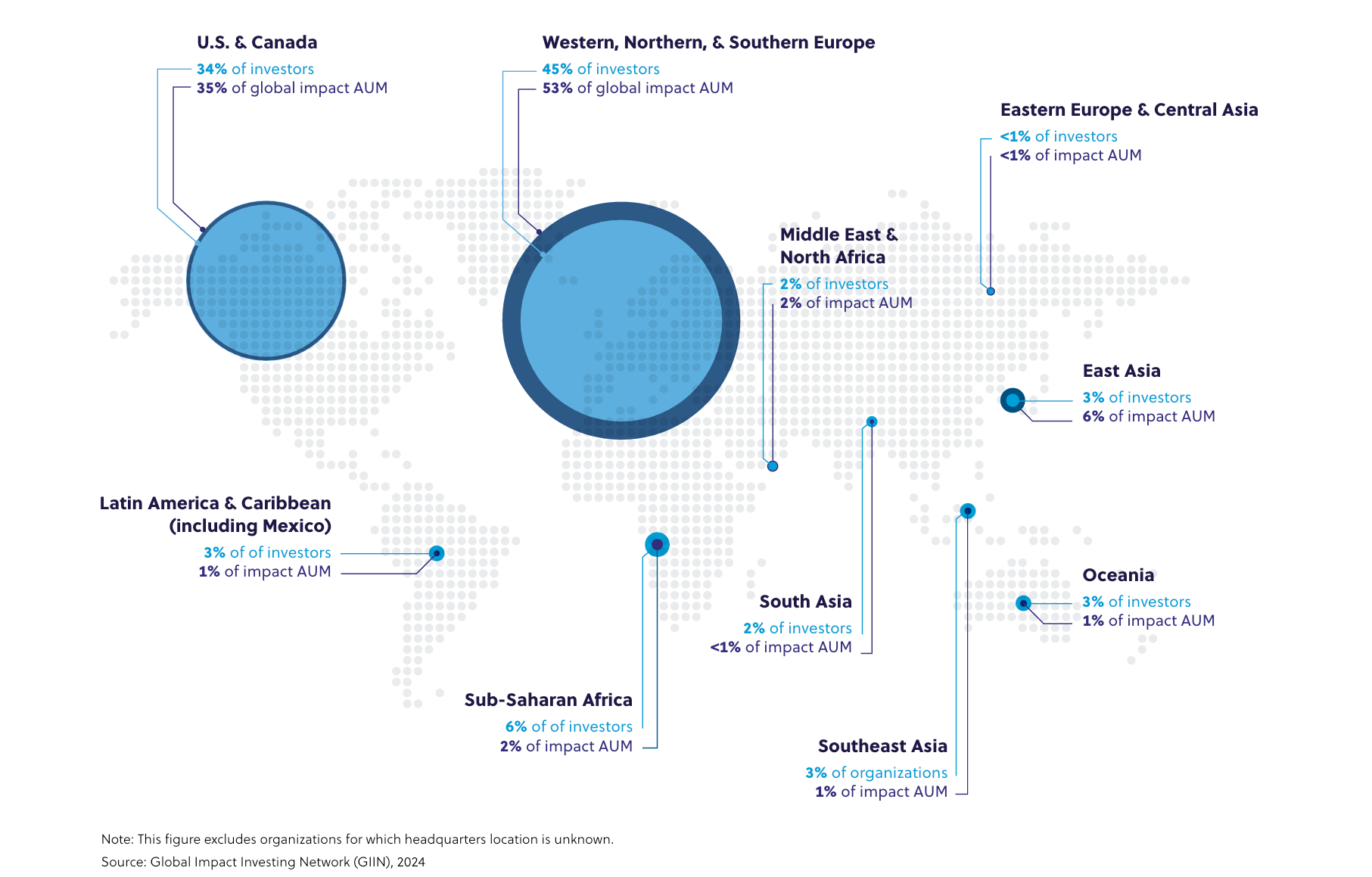
These trends reflect an increasingly palpable recognition that foundations possess resources far greater than their annual grant budgets.
Personally, I also see this growth of impact investing in philanthropy as a heartening signal that many of my peers are moving beyond the stance of preserving an endowment for its own sake. Rather, they are recognizing that an endowment can and should serve the foundation’s purpose in diverse and sustainable ways.
While this progress is heartening, I must also name that there is still much progress to be made. Research published in 2024 found that even among foundations engaged in impact investing, the median allocation was just 5% of investable assets. There is clearly an opportunity for more foundations to explore how their capital might contribute to their missions.
Of course, each foundation must consider its own circumstances, responsibilities, and appetite for risk. But I believe all of us entrusted with stewarding philanthropic resources have a responsibility to ask whether we are making the most of the tools available to us.
For the Bainum Family Foundation, our Catalytic Capital Portfolio represents an important step in that journey, and one we hope will continue to evolve as we learn.
Doubling Down on Doing More
Ultimately, impact investing reflects a mindset that I hope will guide the Bainum Family Foundation for generations to come.
Stewardship is not about preserving assets for preservation’s sake. It is about putting assets to work in ways that create lasting value for society. It is about recognizing that philanthropy’s greatest contribution can only come when every tool available is aligned toward a shared purpose.
Our family has long believed that meaningful change requires more than writing checks. It requires engagement, partnership, learning, and a willingness to adapt.
Today, it also requires us to think carefully about how every asset we steward can contribute to the world we hope to leave behind.
That is why we continue to embrace impact investing. Not because it is fashionable. Not because it is a substitute for grantmaking. But because it reflects our belief that stewardship demands more of us.